Peer Review Process
All manuscripts submitted to JUKANTI (Jurnal Pendidikan Teknologi Informasi) undergo an initial editorial screening and a peer-review process before publication.
JUKANTI applies a double-blind peer review process. The identities of authors and reviewers are concealed from each other during the review process.
Figure 1. Editorial and Peer Review Workflow in JUKANTI
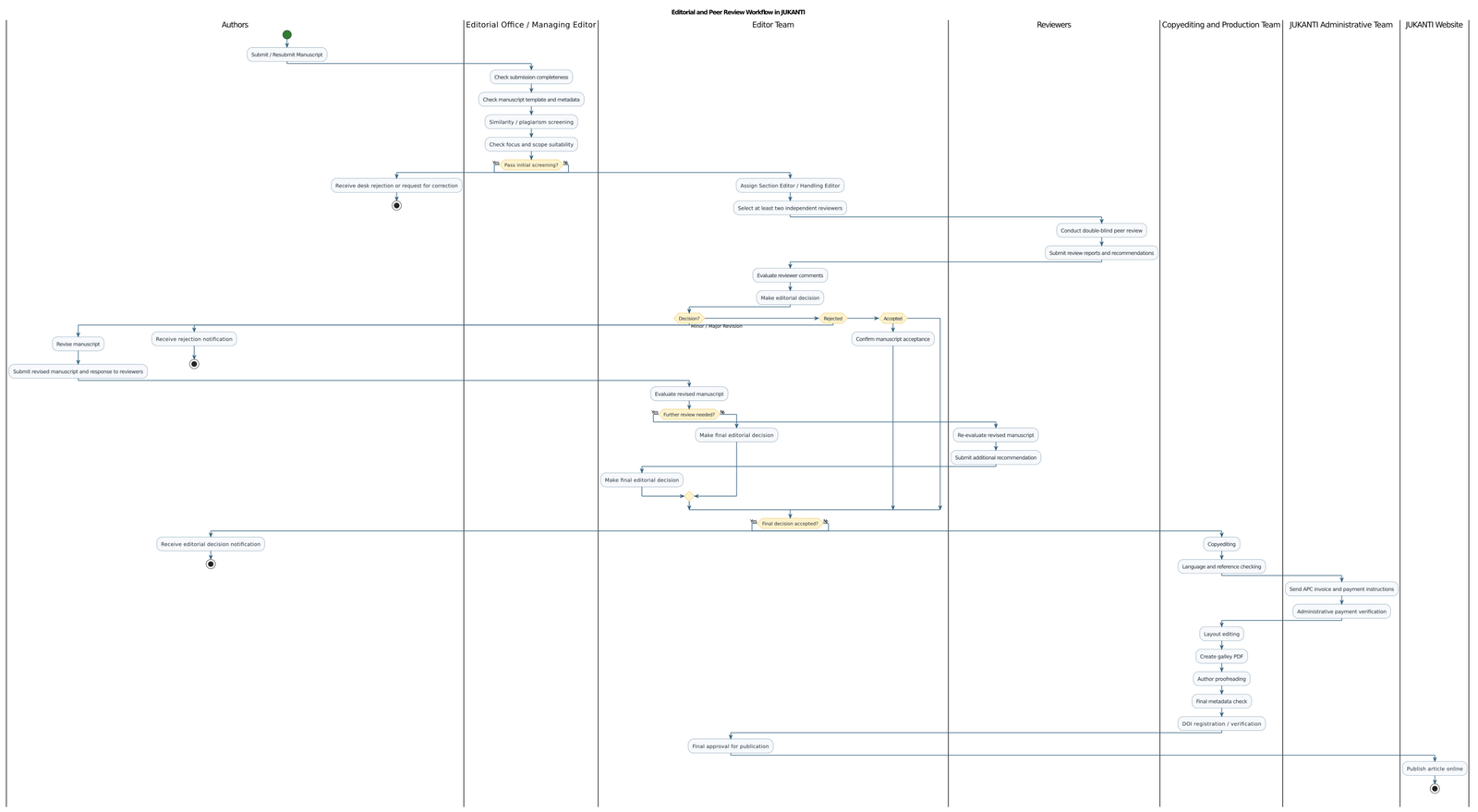
Alt text: Editorial and peer-review workflow in JUKANTI, showing the process from manuscript submission, initial screening, double-blind peer review, editorial decision, revision, copyediting, APC invoice after acceptance, production, DOI verification, and online publication.
Initial Editorial Screening
After submission, each manuscript is checked by the editorial team to assess:
- suitability with the journal’s focus and scope;
- completeness of manuscript metadata;
- compliance with the author guidelines and article template;
- originality and similarity screening results;
- ethical compliance;
- basic quality of writing, structure, and references.
Manuscripts that do not meet the basic requirements may be returned to authors for revision or rejected before peer review.
Peer Review
Manuscripts that pass the initial editorial screening are assigned to at least two independent reviewers with expertise relevant to the manuscript topic.
Reviewers evaluate the manuscript based on:
- originality and contribution to the field;
- relevance to the journal’s focus and scope;
- clarity of research objectives;
- appropriateness of methodology;
- quality of analysis and discussion;
- validity of findings and conclusions;
- quality and relevance of references;
- compliance with publication ethics.
If reviewer recommendations are substantially different, the editor may invite an additional reviewer or make an editorial decision based on the reviewers’ comments and the scholarly quality of the manuscript.
Editorial Decision
Based on the reviewers’ recommendations and editorial assessment, the editor may make one of the following decisions:
- Accepted;
- Minor Revision;
- Major Revision;
- Resubmit for Review;
- Rejected.
The final decision is made by the editor based on reviewer comments, manuscript quality, relevance to the journal scope, originality, ethical compliance, and contribution to the field.
Revision Process
Authors are required to revise their manuscript according to reviewer and editor comments. Revised manuscripts must be submitted together with a response to reviewers explaining how each comment has been addressed.
The editor may return the revised manuscript to the reviewers for further evaluation when necessary.
Copyediting, APC Invoice, and Production
Manuscripts that have been accepted for publication proceed to the copyediting and production stage.
At this stage, the manuscript undergoes copyediting, language and reference checking, layout editing, galley preparation, author proofreading, final metadata checking, DOI registration or verification, and final approval before online publication.
The APC invoice and payment instructions are sent to the corresponding author by the JUKANTI administrative team only after the manuscript has been accepted and enters the copyediting stage. APC payment does not influence editorial decisions, peer-review results, or manuscript acceptance.
Conflict of Interest
Editors and reviewers must declare any potential conflict of interest. Editors will not handle manuscripts in which they have a personal, academic, financial, or institutional conflict of interest. Reviewers are also required to decline review assignments when a conflict of interest exists.
Confidentiality
All manuscripts submitted to JUKANTI are treated as confidential documents. Editors and reviewers must not disclose, discuss, or use any part of the manuscript for personal advantage before publication.
Review Timeline
The peer-review process normally takes approximately 2 to 6 weeks, depending on reviewer availability, manuscript quality, and the number of revision rounds required.
This timeline is an estimate and does not guarantee acceptance or publication.
Final Note
JUKANTI does not guarantee acceptance of any submitted manuscript. All editorial decisions are based on academic quality, originality, relevance, ethical compliance, and the results of the peer-review process.